Top Desert Honeymoon Suites United States: Architectural & Climatic Analysis
Assessing luxury accommodations across North American desert basins requires an understanding of arid microclimates, thermal performance, and low-density land management. Promotional literature frequently uses vague terms like secluded sanctuary or desert oasis to describe properties. These commercial descriptors often mask significant spatial limitations, such as proximity to major arterial roads, shared pool sightlines, or heavy resort foot traffic. Genuine desert luxury relies on structural climate adaptation, generous land buffers between suites, unobstructed canyon or mesa views, and quiet building envelopes.
Environmental Variations in Domestic Basins
Domestic arid regions contain diverse architectural traditions, terrain profiles, and seasonal climate shifts. The high-altitude Colorado Plateau, the low Sonoran Desert, the Mojave scrublands, and the Chihuahuan basins feature distinct spatial setups and structural challenges. strict environmental regulations limit ground disturbance across fragile desert ecosystems. Consequently, premier accommodations operate within restricted supply boundaries, driving rate surges during temperate spring and autumn windows.
Scope of the Analytical Framework
This reference outlines a methodology for evaluating, comparing, and reserving high-end desert accommodations. Analyzing land density, physical layout, microclimatic exposure, and tariff structures reveals key decision factors. The sections below provide a systematic approach for assessing luxury keys across major arid regions. This structured analysis ensures allocated capital secures genuine privacy, thermal comfort, and environmental quality.
Understanding “Top Desert Honeymoon Suites United States”
Deconstructing Commercial Desert Terminology
Evaluating the top desert honeymoon suites united states requires separating marketing claims from physical site dynamics. Resort operators frequently use phrases like private canyon casita, desert retreat, sanctuary suite, and mesa view pavilion interchangeably across sales channels.
Subheading: Evaluating Physical Attributes
Essential Spatial Components
Selecting high-tier desert accommodations requires auditing four structural layers prior to booking.
Structural Verification Protocols
Securing true high-end desert inventory requires checking parcel maps, mesa setbacks, public hiking trail proximity, and internal building orientations.
Deep Contextual Background
Historical Shifts in Arid Resort Design
The development of luxury desert hospitality has undergone significant changes over the past century. Early twentieth-century properties relied heavily on enclosed adobe structures designed to trap cool air, often arranged around tight central courtyards.
Environmental Controls and Supply Limits
Enacting strict land conservation policies has restricted large-scale resort expansion across environmentally sensitive desert basins. Consequently, established properties and redeveloped footprint sites hold a functional monopoly on prime canyon and mesa locations.
Limited room inventory combined with growing leisure demand has altered regional resort economics. Properties unbundle amenities while using dynamic algorithms to maximize room yields during temperate months. Travelers must evaluate suite positioning carefully to ensure paid rates match actual spatial quality.
Conceptual Frameworks and Mental Models
Subheading: Analyzing Desert Models
1. The Solar Shading Coefficient (SSC)
This framework evaluates suite usability by measuring the ratio of direct sunlight to shaded terrace area during peak afternoon thermal windows.
2. The Diurnal Variation Friction Model
This model assesses suite performance by measuring temperature shifts between day and night, checking heating and cooling efficiency.
3. The Topographical Isolation Matrix
This framework measures guest privacy by analyzing mesa contour lines, public hiking trail setbacks, and property walking paths.
Key Categories or Variations
Regional Arid Profiles
Examining major domestic desert regions shows clear differences in architecture, weather risks, and seasonal demand patterns across high-end inventory.
| Regional Category | Primary Spatial Advantage | Operational Trade-Offs | Peak Demand Window |
| Colorado Plateau Suites | Dramatic canyon walls, cool nights | Cold winter weather, high elevation | April to May; September to October |
| Sonoran Desert Casitas | Saguaro forests, warm winter days | Extreme summer heat (110°F+), dense flora | November to April |
| Mojave High-Desert Estates | Stark open vistas, mid-century design | High afternoon winds, dusty conditions | March to May; October to November |
| Chihuahuan Basin Lodges | Remote wilderness solitude, dark skies | Long transit times, sparse services | October to April |
| Palm Oasis Villas | Thermal warmth, lush palm canopies | Higher urban density, traffic noise | December to April |
Detailed Real-World Scenarios
Subheading: Analyzing Scenario A: The High-Desert Plateau Suite
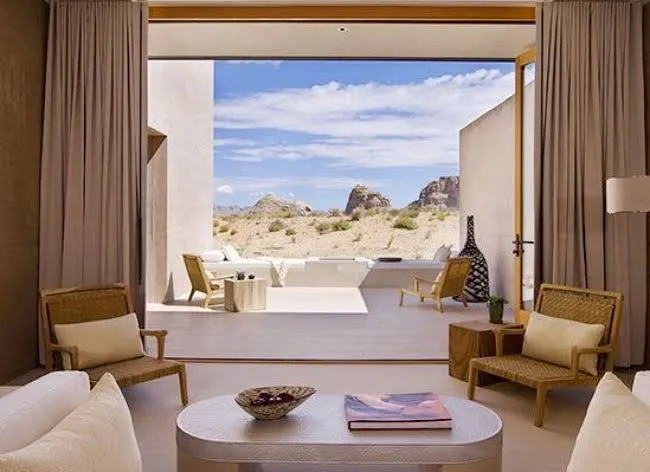
Scenario A: The High-Desert Plateau Suite
A couple books a canyon pavilion in southern Utah for five nights in October.
Environmental Context
Autumn brings warm sunny afternoons, cold desert nights, and clear skies across the Colorado Plateau.
Financial Decisions and Pitfalls
The travelers booked a suite listed at $4,200 per night ($21,000 base total). They assumed the location provided complete warmth during late evening hours.
Operational Impacts
Rapid evening drops in temperature required using supplemental terrace heating to maintain comfortable outdoor living conditions.
Budget Adjustments
Future high-desert bookings require checking pool heating policies and verifying outdoor fire feature operations prior to arrival.
Subheading: Analyzing Scenario B: The Sonoran Valley Casita
Scenario B: The Sonoran Valley Casita
A couple books a private casita near Scottsdale for four nights in May.
Environmental Context
Late spring brings high afternoon temperatures, low humidity, bright sunlight, and active desert wildlife.
Financial Decisions and Pitfalls
The travelers reserved a casita at $2,800 per night ($11,200 base total). They expected to use the outdoor plunge pool throughout the entire afternoon.
Operational Impacts
High afternoon temperatures forced guests indoors between noon and four o’clock, reducing use of the outdoor lounge deck.
Budget Adjustments
Sonoran itineraries should target late autumn or early spring dates to avoid intense afternoon heat spikes.
Planning, Cost, and Resource Dynamics
Structural Capital Allocation
Budgeting for top-tier desert suites requires balancing baseline rates, mandatory service charges, utility fees, and private transit costs.
Expense Distribution Metrics
| Expense Category | Typical Cost Share (%) | Average Price Multipliers | Operational Value Drivers |
| Base Suite Rate | 55% – 65% of budget | 1.0x baseline metric | Direct canyon sightline, private plunge pool |
| Mandatory Fees | 15% – 20% of base rate | 1.15x – 1.20x base rate | Resort fees, environmental preservation charges |
| Utilities & Heating | 10% – 15% of budget | 1.10x – 1.15x service | Plunge pool heating, outdoor fire features |
| Private Transit | 10% – 15% of budget | 1.10x – 1.15x transit | Desert SUV transfers, airport transfers |
Tools, Strategies, and Support Systems
Systematic Verification Steps
Travelers can use concrete verification steps to audit desert properties prior to confirming reservations.
Subheading: Essential Steps for Property Verification
-
Audit Site Plans: Confirm the suite directly faces natural rock formations rather than internal resort access roads.
-
Verify Solar Orientation: Check terrace positioning relative to afternoon sun angles to ensure usable shade cover.
-
Calculate Total Surcharges: Add resort fees, pool heating charges, and local lodging taxes to base rates.
-
Use Preferred Travel Programs: Book through luxury networks to secure room upgrades, breakfast, and property credits.
-
Evaluate Regional Transit: Arrange private transfers early, as ride-share options remain limited across remote desert valleys.
Risk Landscape and Failure Modes
Taxonomy of Arid Property Risks
Failing to evaluate suite orientation, seasonal weather, and fee terms can result in thermal discomfort, loss of privacy, and unexpected costs.
Governance, Maintenance, and Long-Term Adaptation
Subheading: Managing Booking Timelines
Booking Cycles and Inventory Management
Top desert properties manage small room inventories, often offering fewer than thirty standalone casitas per property. High-demand temperate dates sell out months in advance.
Subheading: Pre-Booking Verification Checklist
Pre-Booking Checklist
Review these essential items before confirming final reservations for top desert accommodations.
-
Verify the suite offers direct, unobstructed views of natural desert landscapes.
-
Check that outdoor terrace areas feature structural afternoon shade.
-
Calculate total nightly costs, including resort fees, heating surcharges, and local taxes.
-
Confirm plunge pool heating options and costs for cool evening months.
-
Secure private transportation arrangements for resort transfers and regional tours.
Measurement, Tracking, and Evaluation
Critical Evaluation Metrics
Evaluating desert accommodations requires tracking quantitative room metrics along with qualitative comfort signals.
Real-World Evaluation Examples
-
Example 1: Solar Shade Audit. A suite with a terrace receiving afternoon shade provides greater thermal usability than an unshaded deck facing direct sun.
-
Example 2: Surcharge Calculation. A $3,000 base rate carrying a 15% resort fee, $100 pool heating charge, and 12% tax results in a total daily cost of $3,910.
-
Example 3: Spatial Buffer Check. Positioning a casita three hundred feet from central resort facilities prevents noise disruptions during evening events.
Common Misconceptions and Oversimplifications
Subheading: Correcting Arid Booking Myths
Myth 1: Deserts Are Warm All Year Round
High-desert regions experience freezing temperatures during winter nights, requiring indoor heating and pool warming.
Myth 2: Standalone Casitas Always Guarantee Complete Privacy
Casitas positioned near main walking paths or public pools often suffer from shared sightlines and ambient guest noise.
Myth 3: Private Plunge Pools Are Heated Automatically
Many luxury properties charge daily fees to heat private plunge pools during cooler months.
Ethical, Practical, or Contextual Considerations
Environmental Stewardship and Water Management
Booking luxury desert retreats requires balancing personal comfort with resource conservation. Fragile desert ecosystems face ongoing challenges regarding water scarcity, soil erosion, and habitat fragmentation.
Selecting properties that use low-water landscaping, solar power, and graywater recycling helps protect delicate arid environments. Supporting eco-friendly resorts ensures unique desert landscapes remain preserved for future travel.
Conclusion
Selecting the top desert honeymoon suites united states requires evaluating structural shading, site isolation, and total fee structures rather than relying on promotional names alone. Securing authentic luxury demands auditing parcel maps, room orientations, and seasonal climate patterns prior to booking. Balancing baseline room tariffs with mandatory service fees and utility charges ensures high comfort and long-term value. Thorough research turns a desert stay into a peaceful, memorable, and restorative travel experience.